National Museum of Indonesia
Quick answer
National Museum of Indonesia in Jakarta, Indonesia — indonesia's national museum was founded in 1778 by the Batavian Society of Arts and Sciences and is nicknamed Museum Gajah after the bronze elephant in its forecourt. Open Tuesday to Thursday: 8:00 AM – 6:00 PM; Friday to Sunday: 8:00 AM – 8:00 PM; closed Mondays. Admission: Rp50,000 for Indonesian adults; Rp150,000 for foreign visitors (Rp50,000 for KITAS holders). Allow 2–3 hours.
Visitor information last reviewed 25 September 2026. Check the official museum site for current details.
National Museum of Indonesia at a glance: hours, tickets and time needed
| Opening hours | Tuesday to Thursday: 8:00 AM – 6:00 PM; Friday to Sunday: 8:00 AM – 8:00 PM |
|---|---|
| Closed | Mondays and national public holidays |
| Admission | Rp50,000 for Indonesian adults; Rp150,000 for foreign visitors (Rp50,000 for KITAS holders) |
| Free or reduced entry | Free for children aged 0–3 · Free for seniors over 60 and visitors with disabilities (plus one companion) · Free for KIP and KIP Kuliah card holders · ARAMSA: free entry for all on the second Wednesday of each month, 4:00–8:00 PM · Indonesian students (PAUD to high school): Rp30,000 |
| Booking | Tickets usually available on the day |
| Time needed | 2–3 hours |
| Best time to visit | Come Tuesday to Thursday at 8 AM for the quietest galleries, or on a Friday, Saturday or Sunday evening (open until 8 PM). |
| Getting there | Bus: TransJakarta Corridor 1 (Blok M–Kota) or routes 1A, 1P, 2, 3, 5C, 7F and 14A to Monumen Nasional stop — about a 7-minute walk |
| Address | Jl. Medan Merdeka Barat No. 12, Gambir, Central Jakarta 10110, Indonesia |
| Official website | museumnasional.or.id |
Checked 2026-09-25 against the official website. Prices and hours change — confirm before you travel.
What is National Museum of Indonesia known for?
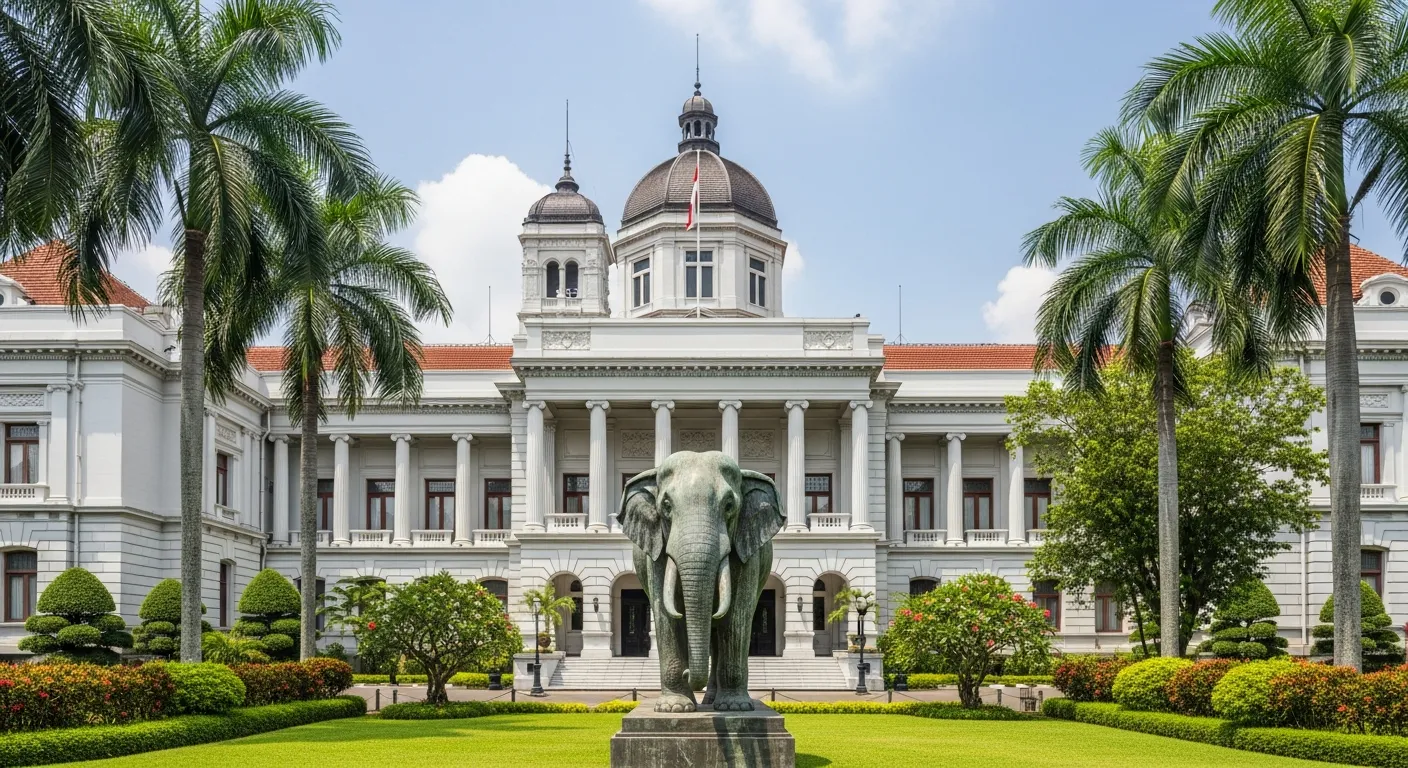
The National Museum of Indonesia grew out of the Bataviaasch Genootschap van Kunsten en Wetenschappen (Batavian Society of Arts and Sciences), founded in Batavia on 24 April 1778, which makes it one of the oldest museums in Southeast Asia. Its colonnaded building on the west side of Merdeka Square opened in 1868. The local nickname Museum Gajah (Elephant Museum) comes from the bronze elephant presented by King Chulalongkorn of Siam in 1871, which still stands in the forecourt. The institution passed to the Indonesian government in 1962 and was renamed Museum Nasional in 1979.
On the night of 16 September 2023 a fire destroyed several rooms at the back of the old Building A, damaging objects in galleries that included prehistory, bronzes, ceramics and Islamic civilisation. The museum reopened on 15 October 2024 with an exhibition of repatriated heritage and a display about the fire and its aftermath. Renewal has continued since: the permanent Sejarah Awal (Early History) exhibition opened in December 2025 as Java Man fossils returned from the Netherlands, and new lamp and coin galleries followed in April 2026. The museum says the six burned rooms still await full renovation.
The collection of more than 140,000 objects is among the richest in Southeast Asia. It is especially strong in Hindu-Buddhist stone sculpture from Java and Sumatra, prehistoric artefacts, Asian ceramics, coins and ethnographic material from across the archipelago. Famous pieces include the monumental Bhairava statue associated with the 14th-century Sumatran king Adityawarman, the Prajnaparamita of Singhasari returned from the Netherlands under a 1977 agreement, and royal treasures from Lombok. Paintings and manuscripts once held here were transferred to the National Gallery and the National Library in the late 20th century.
The museum has two main buildings: the historic Building A (Gedung Gajah) and Building B (Gedung Arca), a modern wing opened in 2007. Visitors now enter through the Hall Majapahit with its video-mapping projections, and a free zone — front gardens, inner courtyard, mosque, air-conditioned canteen and basement — can be used without a ticket. Prices rose in January 2026 to Rp50,000 for Indonesian adults and Rp150,000 for foreign visitors, while evening opening until 8:00 PM from Friday to Sunday and the free monthly ARAMSA evening make after-work visits easy.
Best for: History Enthusiasts · First-timers · Archaeology fans · Families
How long do you need at National Museum of Indonesia?
Allow 2–3 hours. From the elephant in the forecourt to Java Man and the new lamp and coin galleries — the essentials of the National Museum of Indonesia. Follow the stops in order:
- 1
Bronze Elephant and Hall Majapahit
📍 Forecourt and entrance hall
See the 1871 elephant that gave Museum Gajah its name, then enter through the Hall Majapahit with its video-mapping projections.
- 2
Hindu-Buddhist sculpture
📍 Statue galleries
Look for the towering Bhairava associated with King Adityawarman and the finely carved images from Java's classical kingdoms.
- 3
Sejarah Awal (Early History)
📍 Ruang Kertarajasa, Building A
Follow the story from the volcanic birth of the archipelago to Java Man — the Homo erectus fossils returned from the Netherlands in 2025.
- 4
Pendar and Numismatik
📍 Building A, 2nd floor
Entry runs in 30-minute sessions for up to 30 people; look for blencong puppet lamps and early gold and gobog coins.
- 5
ImersifA (optional)
📍 ImersifA room
A projection-mapped journey through Indonesian history; it needs an extra Rp35,000 ticket and is excluded from free ARAMSA entry.
What are the must-see works at National Museum of Indonesia?
5 highlights that define the collection: Java Man (Homo erectus) fossils, Bronze Elephant Statue, Adityawarman as Bhairava and more.
Java Man (Homo erectus) fossils
Dubois Collection · excavated at Trinil, East Java, 1891–1892
📍 Sejarah Awal exhibition, Ruang Kertarajasa, Building A
Fossils of Homo erectus found by Eugène Dubois on the banks of the Bengawan Solo and returned from the Netherlands at the end of 2025 — the centrepiece of the permanent Early History exhibition that opened in December 2025.
Bronze Elephant Statue
Gift of King Chulalongkorn of Siam · 1871
📍 Forecourt of Building A
The bronze elephant presented by the Siamese king in 1871 gave the museum its popular name, Museum Gajah. It stands on a pedestal in front of the colonnaded 1868 façade.
Adityawarman as Bhairava
Padang Roco, West Sumatra · 14th century
A stone statue more than four metres tall, generally identified as the Sumatran king Adityawarman in the fierce form of Bhairava, standing on a corpse above a base of skulls — one of the largest sculptures in the museum.
Prajnaparamita of Singhasari
East Java · 13th century
A serene stone image of the Buddhist goddess of transcendent wisdom, widely regarded as a masterpiece of Javanese sculpture. It returned from the Netherlands under the 1977 cultural-heritage agreement.
Pendar: lamps from the 9th century onward
Majapahit-era and colonial-period lamps
📍 Building A, 2nd floor
A display opened in April 2026 tracing light and lighting from early oil lamps, including the blencong used in shadow-puppet performances, to Majapahit-era lamps and colonial chandeliers and lanterns.
Collections and highlights
- • Java Man and the Sejarah Awal (Early History) exhibition
- • Hindu-Buddhist stone sculpture from Java and Sumatra
- • Prehistoric artefacts and bronzes
- • Asian ceramics
- • Numismatics — coins from Hindu-Buddhist kingdoms to the early Republic
- • Ethnography from across the archipelago
- • Repatriated treasures from Lombok and Singhasari
Tips for visiting National Museum of Indonesia
- 1.
Best time to visit
Come Tuesday to Thursday at 8 AM for the quietest galleries, or on a Friday, Saturday or Sunday evening (open until 8 PM). Avoid Mondays and national public holidays, when the museum is closed.
- 2.
Crowds & busy periods
Weekends and school holidays are busiest; the free ARAMSA evening on the second Wednesday of each month also draws crowds.
- 3.
Tickets & booking
No advance booking needed for individuals. Buy at the counter or e-kiosk, or online via the Traveloka link on museumnasional.or.id. The Pendar and Numismatik rooms admit visitors in 30-minute sessions of up to 30 people.
- 4.
Food & cafés nearby
An air-conditioned canteen sits in the free, unticketed zone; more choice around Jalan Sabang and Sarinah to the south.
- 5.
Accessibility
Free entry for visitors with disabilities plus one companion. Building A dates from 1868 — ask staff about lifts and step-free routes.
- 6.
Photography rules
Personal photography is widely practised in the galleries; follow room signage in special exhibitions and ask before filming for commercial use.
How do you get to National Museum of Indonesia?
- bus TransJakarta Corridor 1 (Blok M–Kota) or routes 1A, 1P, 2, 3, 5C, 7F and 14A to Monumen Nasional stop — about a 7-minute walk
- metro MRT Jakarta to Bundaran HI, then TransJakarta 1 or 1P north to Monumen Nasional
- train KRL Commuter Line to Juanda, then TransJakarta route 2 or 14A to Monumen Nasional
- taxi Grab, Gojek or Bluebird to Museum Nasional, Jl. Medan Merdeka Barat No. 12
Address: Jl. Medan Merdeka Barat No. 12, Gambir, Central Jakarta 10110, Indonesia
National Museum of Indonesia: frequently asked questions
How much are tickets at the National Museum of Indonesia?
Since 1 January 2026, admission is Rp50,000 for Indonesian adults, Rp30,000 for Indonesian students (PAUD to high school) and Rp150,000 for foreign visitors; foreigners holding a KITAS pay Rp50,000. Children aged 0–3 enter free. The ImersifA immersive room costs an extra Rp35,000 and requires a museum ticket. Tickets are sold at the counter and e-kiosk, or online through the Traveloka link on the official website.
What are the opening hours?
Since 1 April 2026 the museum opens Tuesday to Thursday from 8:00 AM to 6:00 PM and Friday to Sunday from 8:00 AM to 8:00 PM. It is closed every Monday and on national public holidays. On the second Wednesday of each month the ARAMSA programme opens the galleries free of charge from 4:00 to 8:00 PM.
Is the museum open again after the 2023 fire?
Yes. A fire on the night of 16 September 2023 destroyed rooms at the back of the historic Building A, and the museum reopened on 15 October 2024. New displays have opened since, including the permanent Sejarah Awal (Early History) exhibition with the Java Man fossils in December 2025 and lamp and coin galleries in April 2026. The museum says the six burned rooms still await full renovation.
Who can enter for free?
Free admission applies to children aged 0–3, seniors over 60, visitors with disabilities plus one companion, and students holding KIP or KIP Kuliah cards; supporting documents are checked. Everyone can also enter free during ARAMSA, 4:00–8:00 PM on the second Wednesday of each month, by scanning a QR code at the ticket counter (not online or at the e-kiosk). ARAMSA does not cover ImersifA or other add-ons.
What should I not miss?
Start with the bronze elephant presented by King Chulalongkorn of Siam in 1871, then head to the Sejarah Awal exhibition in Building A, where Java Man (Homo erectus) fossils returned from the Netherlands are displayed. The museum's Hindu-Buddhist sculpture — including the towering Bhairava statue associated with King Adityawarman — and the new Pendar lamp and Numismatik coin rooms on the second floor of Building A are further highlights.
How long should I spend at the National Museum of Indonesia?
Plan 2–3 hours for the highlights of National Museum of Indonesia. Our 5-stop route — Bronze Elephant and Hall Majapahit, Hindu-Buddhist sculpture, Sejarah Awal (Early History) and more — is designed to fit that time. Add extra time for temporary exhibitions, the shop and the café.
How do I get there by public transport?
Take TransJakarta Corridor 1 (Blok M–Kota) or routes such as 1A, 2 or 3 to the Monumen Nasional stop on Jalan Medan Merdeka Barat, then walk about seven minutes. From MRT Bundaran HI station, change to TransJakarta 1 or 1P heading north. KRL Commuter Line riders can get off at Juanda station and connect on TransJakarta route 2 or 14A to Monumen Nasional.
Can I combine the museum with Monas?
Yes. The museum stands on the west side of Merdeka Square, within walking distance of the National Monument (Monas). A popular plan is the museum at its 8:00 AM opening followed by Monas later in the day. The Kota Tua museums, including the Jakarta History Museum and Wayang Museum, are further north along TransJakarta Corridor 1.
Is National Museum of Indonesia open on Mondays?
No — National Museum of Indonesia is closed every Monday (closing days: Mondays and national public holidays). It is open Tuesday to Thursday: 8:00 AM – 6:00 PM; Friday to Sunday: 8:00 AM – 8:00 PM. Plan a different museum for that day, and check the official website for holiday changes.