Tate Modern
London · United Kingdom · Founded 2000
Quick answer
Tate Modern is an art gallery located in London, housing the United Kingdom's national collection of international modern and contemporary art created from 1900 to the present day. Open Sunday to Thursday: 10:00 AM – 6:00 PM; Friday and Saturday: 10:00 AM – 9:00 PM. Admission: free standard admission; charges for special exhibitions. Allow 2–3 hours.
Visitor information last reviewed 25 September 2026. Check the official museum site for current details.
Tate Modern at a glance: hours, tickets and time needed
| Opening hours | Sunday to Thursday: 10:00 AM – 6:00 PM; Friday and Saturday: 10:00 AM – 9:00 PM |
|---|---|
| Last entry | 30 minutes before closing |
| Admission | Free standard admission; charges for special exhibitions |
| Free access | Collection always free (no booking needed) · Exhibitions ticketed · Up to 4 under-12s free per adult at exhibitions · £5 exhibition tickets for 16–25s via Tate Collective |
| Booking | Tickets usually available on the day |
| Time needed | 2–3 hours |
| Best time to visit | Weekday mornings are consistently the quietest. |
| Getting there | Metro: Southwark (Jubilee Line) — 10-minute walk via Bankside |
| Address | Bankside, London SE1 9TG, United Kingdom |
| Official website | tate.org.uk |
Checked 2026-09-25 against the official website. Prices and hours change — confirm before you travel.
What is Tate Modern known for?
Tate Modern is an art gallery located in London, housing the United Kingdom's national collection of international modern and contemporary art created from 1900 to the present day. It is part of the Tate group, together with Tate Britain, Tate Liverpool, and Tate St Ives.
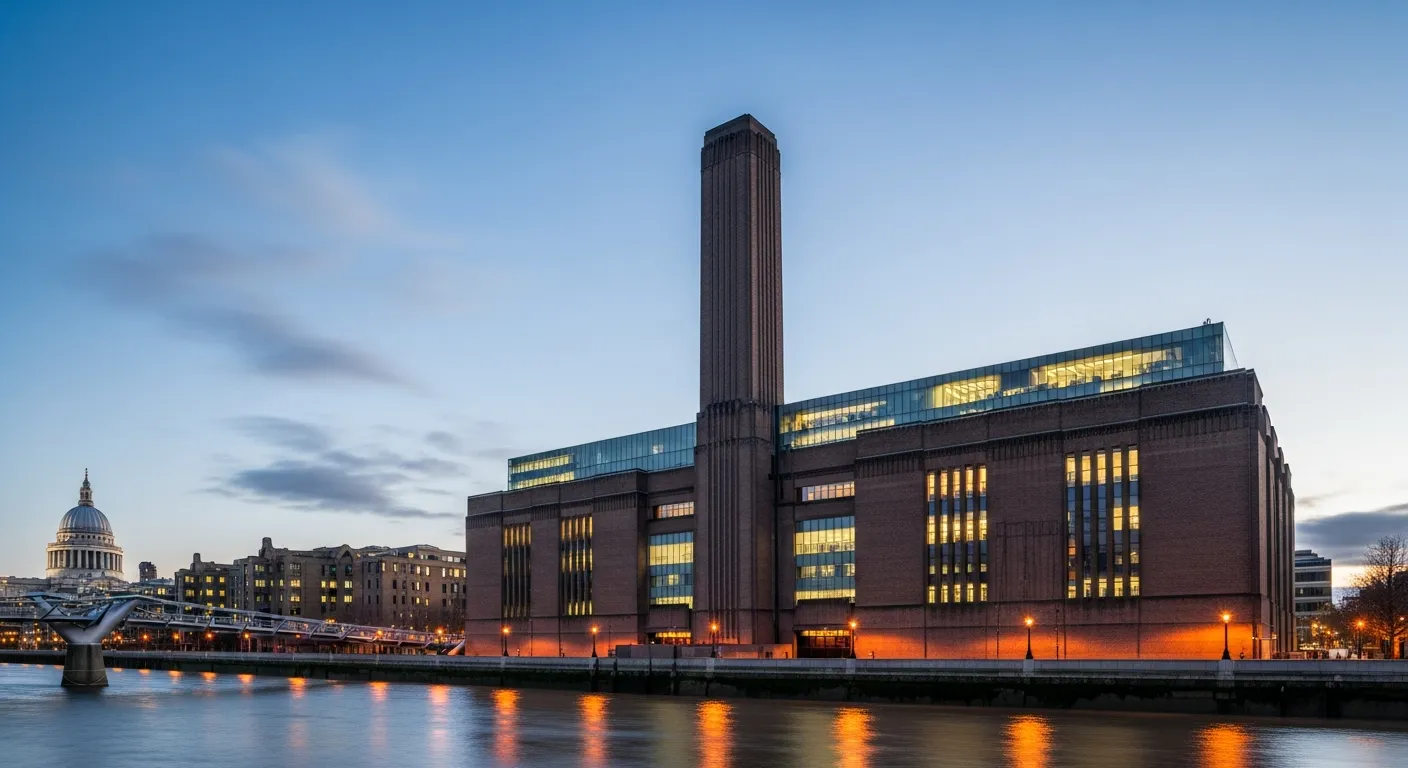
The museum is housed in the former Bankside Power Station, originally designed by Sir Giles Gilbert Scott. The conversion was carried out by Swiss architects Herzog & de Meuron, who retained much of the original character of the building.
Tate Modern is one of the largest museums of modern and contemporary art in the world. As with other national British museums, entry to the collection display is free of charge, except for the temporary exhibitions.
The vast Turbine Hall, formerly housing the electricity generators of the old power station, hosts a hugely popular series of specially commissioned works by contemporary artists.
Best for: Art Lovers · Contemporary Art · Families · First-timers
What's on at Tate Modern: current exhibitions
Updated September 2026. Confirm dates and tickets on the official Tate Modern website.
Frida: The Making of an Icon
Until 3 January 2027How Frida Kahlo became a global cultural and commercial icon, pairing her paintings with works by her contemporaries and objects carrying her image.
Tickets: £25; concessions available; £5 for 16–25s with Tate Collective
Light and Magic: The Birth of Art Photography
Opens soon · 14 October 2026 – 21 February 2027The first major exhibition on pictorialism as a global movement, with over 200 rare prints by more than 80 photographers.
Tickets: £20; £19 concessions
Hyundai Commission: Tarek Atoui
Opens soon · 13 October 2026 – 11 April 2027Artist and composer Tarek Atoui creates a new site-specific sound work for the Turbine Hall.
Tickets: Free
Contemporary Art on the South Bank
Tate Modern occupies the former Bankside Power Station, transformed by Herzog and de Meuron into London's most visited modern art museum. The Turbine Hall's industrial scale hosts annual commissioned installations that often become city-wide talking points. Free general admission covers the permanent collection; timed tickets apply only to major temporary exhibitions on the top floor. Bankside Power Station chimneys no longer generate electricity but remain part of the protected industrial heritage facade. The Clore Learning Centre hosts family workshops on weekends separate from general admission requirements. Member lounges and early entry slots reward Tate membership for repeat London visitors. River Thames boat services stop at Bankside Pier steps from the museum entrance. Bankside Power Station conversion preserved industrial brick and chimney forms that contrast dramatically with the Blavatnik Switch House glass extension.
The Switch House extension added ten stories of gallery space and a viewing terrace overlooking St Paul's Cathedral and the Thames. Southwark Tube station and Blackfriars bridge connections make the museum easy to combine with Shakespeare's Globe or Borough Market. Weekends draw crowds to popular works by Picasso, Dalí, and Rothko; weekday evenings after work offer quieter viewing. Collection rehangs occur periodically, so online room listings may differ slightly from last visit. Tate St Ives and Tate Britain are separate institutions but share membership benefits for UK residents. Turbine Hall commissions by artists including Olafur Eliasson and Ai Weiwei have become London cultural events drawing visitors beyond regular collection audiences.
River bus and Millennium Bridge link Tate Modern to St Paul's and Tate Britain downstream via boat. Photography for personal use is permitted in most collection galleries without flash. Allow two to three hours for collection highlights plus Turbine Hall, longer if attending a special exhibition. Bankside Power Station chimneys no longer generate electricity but remain part of the protected industrial heritage facade. The Clore Learning Centre hosts family workshops on weekends separate from general admission requirements. Member lounges and early entry slots reward Tate membership for repeat London visitors. River Thames boat services stop at Bankside Pier steps from the museum entrance. Collection displays organize much twentieth-century art thematically rather than chronologically, encouraging unexpected juxtapositions between movements and continents.
Modern Masters and Living Artists
The collection spans 1900 to present, organized thematically rather than strictly chronologically in many rooms, which encourages unexpected juxtapositions. Surrealism, Abstract Expressionism, and Minimalism galleries hold masterworks by Dalí, Rothko, and Twombly alongside feminist and global south rehangs reflecting Tate's revised narratives. Live performance and film programs activate collection themes beyond static painting. Collection rehangs occur periodically, so online room listings may differ slightly from last visit. Tate St Ives and Tate Britain are separate institutions but share membership benefits for UK residents. Rothko Seagram Murals occupy a dedicated subdued room where seating encourages extended contemplation away from the busiest collection corridors.
Artist Rooms rotating displays focus on single figures like Louise Bourgeois or Donald Judd, drawn from Anthony d'Offay's transformative gift. The Tanks preserve raw oil-storage spaces for time-based media and experimental programming. Tate's acquisition of NFTs and digital works signals ongoing expansion of medium definitions. Tate membership includes unlimited exhibition access and early entry slots that reduce congestion during blockbuster temporary show openings.
Membership and Tate Patrons programs fund acquisitions while offering unlimited exhibition access. The shop sells exhibition posters and design objects aligned with modernist aesthetics. Tate Modern complements rather than replaces Tate Britain's historical British art focus across the river. River Thames path connects Tate Modern to St Paul's Cathedral via Millennium Bridge in a ten-minute walk with iconic skyline views.
Making the Most of Bankside
Tate Modern's riverside location invites a Thames walk to Shakespeare's Globe or Borough Market after your visit — plan lunch at the market if visiting Saturday morning before afternoon crowds peak. Members enter through a dedicated queue that saves substantial time during blockbuster exhibitions requiring timed slots.
The Blavatnik Building extension added ten floors of gallery space connected by dramatic staircases with panoramic London views. Level 10 viewing terrace is free with admission and offers one of the best unpaid skyline vistas in the city, especially at sunset on late Friday openings.
Wing-by-wing visitor guide
Focused routes for Tate Modern — pick one wing per visit to avoid museum fatigue.
Turbine Hall
⏱ 30 minutesThe cavernous entrance hall measures 152 meters long and 35 meters high, built for annual Hyundai Commission installations. Even between commissions, the industrial architecture impresses as much as any artwork. Hyundai Commission installations change annually and often fill the entire Turbine Hall volume with sculpture, light, or participatory architecture.
- • Hyundai Commission annual installation
- • Original power station brick and steel structure
- • Bridge crossing at mid-height
- • Free entry without collection ticket
- • Accessibility ramps and wide sightlines
Collection Displays Level 4
⏱ 90 minutesStart here for twentieth-century painting and sculpture: Cubism, Surrealism, and post-war abstraction in open-plan rooms. Rothko's Seagram Murals occupy a dedicated subdued chapel-like space. Level 4 Surrealist and Cubist rooms include Dalí Lobster Telephone and Picasso Weeping Woman within open-plan sightlines across multiple masterpieces.
- • Picasso Weeping Woman and Cubist works
- • Dalí Lobster Telephone and Surrealist room
- • Rothko Seagram Murals quiet room
- • Bourgeois spider and room installations nearby
- • Pop Art including Lichtenstein and Warhol
Blavatnik Building Levels 0–3
⏱ 75 minutesThe Switch House extension holds contemporary art, performance spaces, and the Level 10 viewing platform. Thematic rooms address identity, politics, and global contemporary practice since 1960. Level 10 Blavatnik terrace provides free panoramic views of St Paul's, the Shard, and the City financial district skyline.
- • Level 10 panoramic London terrace
- • Contemporary global artists rotating displays
- • Performance and film in the Tanks below
- • Louise Bourgeois and feminist art rehangs
- • Interactive and media-based installations
How long do you need at Tate Modern?
Allow 2–3 hours. A focused route through 3 must-see highlights at Tate Modern without museum fatigue. Follow the stops in order:
- 1
The Snail
📍 Level 4, In the Studio
One of Matisse's last great works, made when he was 84 and too ill to paint — he cut and pinned shapes of colour-painted paper into a swirling spiral composition.
- 2
CAPITAL
📍 Large Turbine Hall rotations
Beuys' enigmatic installation using blackboards, batteries, copper elements, and felt explores his idea of "social sculpture" — the belief that art should reshape society.
- 3
Do Women Have To Be Naked To Get Into the Met. Museum?
📍 Collection galleries
A billboard-scale activist poster asking why 85% of nudes in the Met are female while fewer than 5% of artists are.
What are the must-see works at Tate Modern?
3 highlights that define the collection: The Snail, CAPITAL, Do Women Have To Be Naked To Get Into the Met. Museum?.
The Snail
Henri Matisse · 1953
📍 Level 4, In the Studio
One of Matisse's last great works, made when he was 84 and too ill to paint — he cut and pinned shapes of colour-painted paper into a swirling spiral composition. The cut-outs mark a triumphant final chapter in his career.
CAPITAL
Joseph Beuys · ongoing installation
📍 Large Turbine Hall rotations
Beuys' enigmatic installation using blackboards, batteries, copper elements, and felt explores his idea of "social sculpture" — the belief that art should reshape society.
Do Women Have To Be Naked To Get Into the Met. Museum?
Guerrilla Girls · 1989
📍 Collection galleries
A billboard-scale activist poster asking why 85% of nudes in the Met are female while fewer than 5% of artists are. One of the most influential works of institutional critique in contemporary art.
Collections and highlights
- • The Snail by Henri Matisse
- • Three Studies for Figures at the Base of a Crucifixion by Francis Bacon
- • The Turbine Hall commissions
- • Marilyn Diptych by Andy Warhol
- • Weeping Woman by Pablo Picasso
Tips for visiting Tate Modern
- 1.
Best time to visit
Weekday mornings are consistently the quietest. The free Turbine Hall commission is worth seeing at any time, including evenings.
- 2.
Tickets & booking
The permanent collection and Turbine Hall are free — no booking required. Major temporary exhibitions require paid tickets, bookable online. The viewing level on the Blavatnik Building is free and offers outstanding views of London.
- 3.
Accessibility
Fully accessible throughout. All levels reached by lift from the Turbine Hall. Tactile tours, audio descriptions, and BSL-interpreted events available. Contact the museum to arrange accessible visits in advance.
- 4.
Photography rules
Photography for personal use is permitted in most areas. Flash and tripods are not allowed. Some contemporary works restrict photography — follow posted signs.
How do you get to Tate Modern?
- metro Southwark (Jubilee Line) — 10-minute walk via Bankside
- metro Blackfriars (District & Circle Lines) — 10-minute walk across Millennium Bridge
- walk Cross the Millennium Bridge from St Paul's Cathedral (7 minutes) · Thames riverside walk from London Bridge (10 minutes)
- bus Lines 45, 63, 100, 344, RV1 — stop: Tate Modern / Bankside
Address: Bankside, London SE1 9TG, United Kingdom
Tate Modern: frequently asked questions
Is Tate Modern free to visit?
Yes — admission to Tate Modern's permanent collection is entirely free. Special temporary exhibitions carry a ticket price (typically £20–£25). Tate Modern is open Sunday to Thursday 10:00 AM to 6:00 PM, and until 9:00 PM on Fridays and Saturdays. No booking is required for the free permanent collection. The Turbine Hall — the vast former power station floor used for major commissioned works — is also always free.
What is the Turbine Hall at Tate Modern?
The Turbine Hall is the enormous central hall of the former Bankside Power Station that now forms Tate Modern's dramatic entrance. At 155 metres long, 35 metres high, and 23 metres wide, it is one of the largest indoor art spaces in the world. Since 2000 it has hosted an annual series of monumental, site-specific commissions — the Unilever Series and later the Hyundai Commission — by artists including Olafur Eliasson (The Weather Project, 2003), Louise Bourgeois, and Carsten Höller.
What are the most famous works at Tate Modern?
The Snail (1953) by Henri Matisse — one of his last major works, a large-scale cut paper collage; Three Studies for Figures at the Base of a Crucifixion (c. 1944) by Francis Bacon; Marilyn Diptych (1962) by Andy Warhol — 50 silk-screened images of Marilyn Monroe in two panels; Weeping Woman (1937) by Picasso; and the permanent Mark Rothko room — eight large-format canvases from the Seagram Murals series, originally commissioned for the Four Seasons restaurant in New York and donated to Tate by Rothko himself in 1969.
What is the difference between Tate Modern and Tate Britain?
Both are free national galleries of art and part of the Tate group, but they have distinct focuses. Tate Modern, on the South Bank, holds the national collection of international modern and contemporary art from 1900 to the present — including works by Picasso, Dalí, Warhol, Bourgeois, and Hirst. Tate Britain, in Millbank (about 2 miles away), holds the national collection of British art from 1500 to the present, including Turner, Constable, Blake, Bacon, and Hockney. Tate Britain also hosts the Turner Prize.
How long does a visit to Tate Modern take?
Tate Modern occupies two interconnected buildings: the original Bankside Power Station (Boiler House) and the new Blavatnik Building (Switch House), which opened in 2016. A focused visit to the main collection highlights across both buildings takes 2–3 hours. A thorough visit including the Turbine Hall commission, the permanent galleries, and a temporary exhibition takes a full day. The museum's top-floor restaurant has panoramic views of St Paul's Cathedral and the Thames.
How long should I spend at Tate Modern?
Plan 2–3 hours for the highlights of Tate Modern. Our 3-stop route — The Snail, CAPITAL, Do Women Have To Be Naked To Get Into the Met. Museum? and more — is designed to fit that time. Add extra time for temporary exhibitions, the shop and the café.
What are Tate Modern's opening hours?
Tate Modern is open Sunday to Thursday: 10:00 AM – 6:00 PM; Friday and Saturday: 10:00 AM – 9:00 PM. Last entry: 30 minutes before closing. Hours can change for holidays and events, so check the official website before you go.