Centre Pompidou
Closed for renovation
The Beaubourg building closed on 22 September 2025 for a full renovation and is due to reopen in 2030. Centre Pompidou exhibitions continue in Paris at partner venues including the Grand Palais.
Quick answer
Centre Pompidou in Paris, France is currently closed: The Beaubourg building closed on 22 September 2025 for a full renovation and is due to reopen in 2030. Centre Pompidou exhibitions continue in Paris at partner venues including the Grand Palais. World Museum Guide keeps its highlights and history here and will update visitor details when it reopens.
Visitor information last reviewed 25 September 2026. Check the official museum site for current details.
Is Centre Pompidou open?
| Status | The Beaubourg building closed on 22 September 2025 for a full renovation and is due to reopen in 2030. Centre Pompidou exhibitions continue in Paris at partner venues including the Grand Palais. |
|---|---|
| Address | Place Georges-Pompidou, 75004 Paris, France |
| Official website | centrepompidou.fr |
Checked 2026-09-25 against the official website. Prices and hours change — confirm before you travel.
What is Centre Pompidou known for?
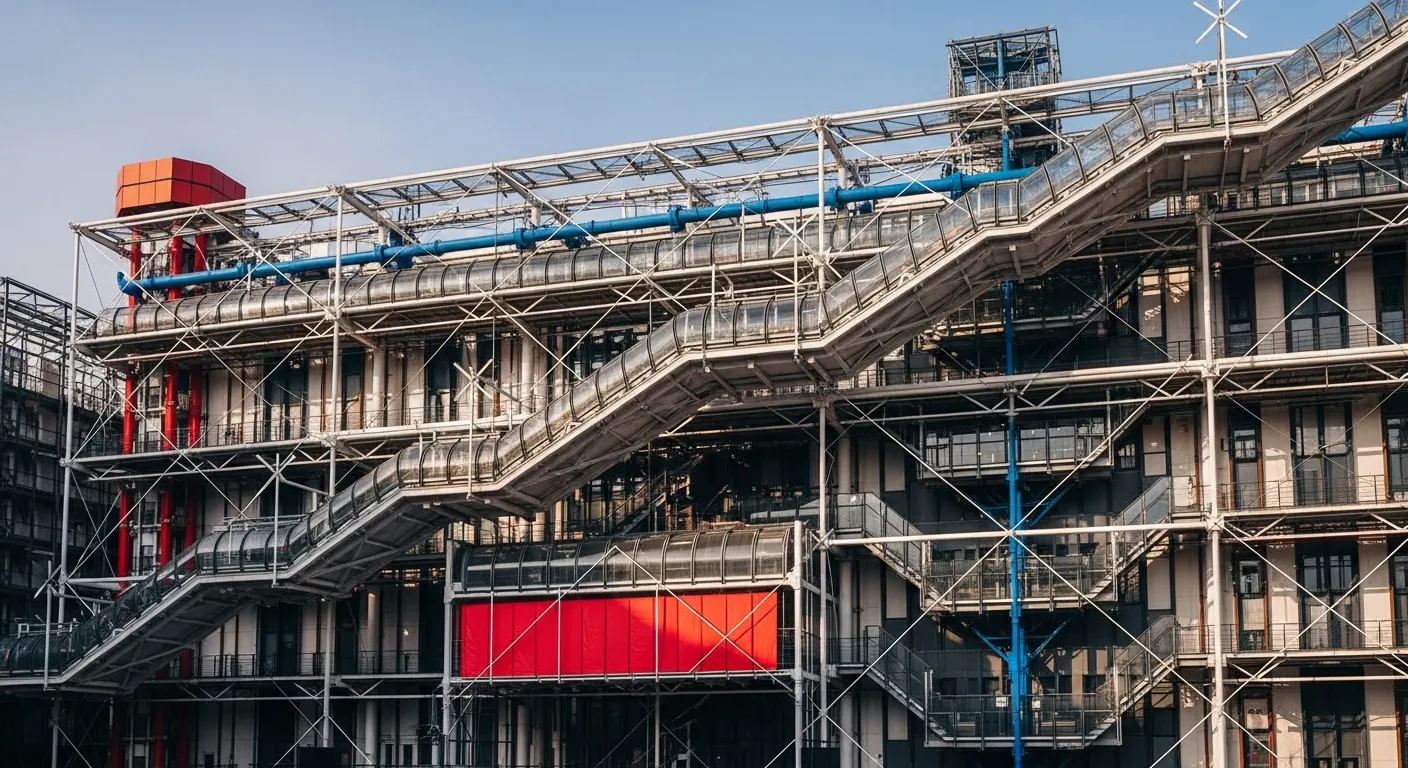
The Centre Pompidou opened in 1977 as France's national museum of modern and contemporary art — and as one of the most radical architectural statements of the 20th century. Designed by Renzo Piano, Richard Rogers, and Gianfranco Franchini, the building turned architecture inside out: colour-coded pipes, ducts, and escalators adorn the exterior while the interior offers vast column-free gallery spaces.
The Musée National d'Art Moderne holds the second-largest collection of modern art in the world after MoMA — over 120,000 works from 1905 to the present. Masterpieces by Matisse, Picasso, Kandinsky, Miró, Dalí, Pollock, and Klein are displayed alongside contemporary installations in a chronological hang across two floors.
The public piazza in front of the Centre — Place Georges-Pompidou — has been a stage for street performers, political rallies, and Parisian life since the building opened. The rooftop terrace offers panoramic views over Paris from Montmartre to the Eiffel Tower, accessible with a separate panorama ticket or with museum admission.
The Centre is currently undergoing a major renovation (2025–2030) with phased gallery closures — check the official website before visiting. Even during renovation, the building, rooftop, and key collection galleries remain accessible, and the Beaubourg neighbourhood offers some of Paris's best contemporary art galleries and cafés.
Best for: Art Lovers · First-timers
Inside-Out Modern Architecture
The Centre Pompidou's exposed ductwork, escalator tubes, and color-coded structural frame shocked Paris when Renzo Piano and Richard Rogers opened it in 1977. Free permanent collection access to the modern masters floor ended recently; check current ticket policy before planning budget. Place Georges Pompidou plaza hosts street performers and attracts crowds independent of museum entry. Place Igor Stravinsky fountain with Niki de Saint Phalle sculptures entertains children before museum entry. Public Information Library on lower levels serves researchers independently of museum ticket purchase. Street performers and portrait artists fill the piazza year-round creating a festival atmosphere around the building. View from level six terrace includes Eiffel Tower, Sacré-Coeur, and Montparnasse Tower on clear days. Renzo Piano and Richard Rogers exposed ductwork design shocked Paris in 1977 and remains among the twentieth century's most debated museum architectures.
The escalator ascent offers progressively expanding Paris rooftop views culminating at level six. Marais district galleries and restaurants surround the museum within walking distance. Wednesday late closing suits evening visits after other museums close. Pompidou-Metz branch in Lorraine extends programming during Paris renovation closure periods planned for future years. Kid-friendly workshops in the Studio require separate booking on weekends and school holidays. Place Igor Stravinsky fountain with Niki de Saint Phalle sculptures entertains children before museum entry. Public Information Library on lower levels serves researchers independently of museum ticket purchase. Street performers and portrait artists fill the piazza year-round creating a festival atmosphere around the building. Color-coded structural frame identifies mechanical systems in blue, circulation in red, and plumbing in green across the inside-out facade. View terrace on level six includes Eiffel Tower and Sacré-Coeur sightlines on clear Paris afternoons.
Temporary exhibitions on levels one and six often require separate timed tickets for blockbuster retrospectives. Library and IRCAM music research center occupy portions of the building beyond visual art galleries. Allow two hours for modern collection, three if adding contemporary floors thoroughly. View from level six terrace includes Eiffel Tower, Sacré-Coeur, and Montparnasse Tower on clear days. Pompidou-Metz branch in Lorraine extends programming during Paris renovation closure periods planned for future years. Kid-friendly workshops in the Studio require separate booking on weekends and school holidays. Level five modern collection spans 1905 through 1960 with Matisse, Picasso, Kandinsky, and Miró in open-plan rooms suited to sketching. Kid-friendly Studio workshops require separate weekend booking during French school holiday periods.
Modern and Contemporary Masterworks
Level five presents 1905 to 1965 modern art with Matisse, Picasso, Kandinsky, and Miró in open-plan rooms suited to sketching and study. Masterworks include Duchamp Fountain replica context and Braque Cubist still lifes alongside Surrealist objects. Level four continues through Pop Art, Minimalism, and 1960s experimental film. Level four contemporary galleries rotate video, installation, and new media reflecting global art centers beyond traditional Parisian focus. IRCAM music research center occupies part of the building beyond visual art gallery floors.
Brancusi Studio reconstruction on level four preserves the sculptor's workshop arrangement legally contested for decades before Pompidou acquisition. Contemporary galleries rotate video, installation, and new media reflecting global art centers beyond Paris. The view terrace on level six remains accessible with museum ticket. Brancusi Studio reconstruction preserves the sculptor's workshop arrangement as a unified artwork including bases and tools as intentional composition. Pompidou-Metz satellite branch in Lorraine extends programming during future Paris renovation closure years.
Photography policies vary by gallery and exhibition; contemporary installations may prohibit all images. Member passes reduce queue time during popular retrospectives. Pompidou Metz and forthcoming relocation plans will eventually close the Paris building temporarily for renovation. Place Georges Pompidou plaza hosts street performers and portrait artists creating festival atmosphere around the museum entrance year-round. Stravinsky fountain with Niki de Saint Phalle sculptures entertains children in the piazza before entry.
Beaubourg and Modern Paris
Exterior escalators in Renzo Piano's inside-out building offer free Paris rooftop views even without entering galleries — but permanent collection tickets include the sixth-floor panorama terrace. Place Georges Pompidou plaza attracts street performers worth watching before descending to Les Halles food halls for lunch.
Contemporary collection rotates frequently — check whether major temporary exhibitions require separate tickets before assuming general admission covers everything. Stravinsky Fountain beside the museum provides a colourful photo stop with Niki de Saint Phalle sculptures.
Wing-by-wing visitor guide
Focused routes for Centre Pompidou — pick one wing per visit to avoid museum fatigue.
Modern Collection (1905–1960)
⏱ 90 minutesLevel five traces Fauvism through Abstract Expressionism with Matisse Dance, Picasso Demoiselles studies nearby, and Kandinsky abstractions. Open sightlines encourage non-linear exploration. Matisse Luxe Calme et Volupté and Dance studies on level five demonstrate Fauvist color liberation that influenced twentieth-century painting globally.
- • Matisse Luxe Calme et Volupté color fields
- • Picasso Cubist and analytic period works
- • Kandinsky Improvisation abstractions
- • Miró playful biomorphic forms
- • Duchamp readymades and conceptual context
Contemporary Art (1960–Present)
⏱ 75 minutesLevel four holds Pop Art, Minimalism, and contemporary installation reflecting global pluralism. Rotating displays emphasize video, performance documentation, and new media. Warhol silkscreens and Klein monochrome works on level four document Pop Art and Nouveau Réalisme responses to post-war consumer culture.
- • Warhol and Pop Art silkscreens
- • Klein monochrome and body print works
- • Minimalist sculpture and serial forms
- • Contemporary video installation rooms
- • Rotating solo artist project spaces
Brancusi Studio
⏱ 30 minutesConstantin Brancusi's reconstructed Paris studio presents sculptures, bases, and tools as the artist arranged them, treating the workshop itself as a unified artwork. Brancusi Endless Column maquettes and Bird in Space bronzes in the studio reconstruction show the artist's serial refinement of form.
- • Endless Column maquette versions
- • Bird in Space polished bronze forms
- • Sleeping Muse marble heads
- • Workshop tools and plaster casts
- • Artist-intended spatial arrangement preserved
What are the must-see works at Centre Pompidou?
4 highlights that define the collection: Fontaine, The Frame, Two Figures and more.
Fontaine
Marcel Duchamp · 1917 (replica)
📍 Level 4, Modern Collection
Duchamp's readymade — a porcelain urinal signed 'R. Mutt' that challenged the very definition of art. The Centre Pompidou holds one of the authorised replicas, displayed alongside the most comprehensive Duchamp collection in Europe.
The Frame
Frida Kahlo · 1938
📍 Level 4, Modern Collection
A self-portrait in which Kahlo's face is framed by a decorative border she painted herself — blending Mexican folk art with Surrealist self-examination. One of the few Kahlo works in a European public collection.
Two Figures
Francis Bacon · 1953
📍 Level 5, Contemporary Collection
Bacon's anguished figures writhing on a bed — painted during the artist's most intense period of creative output in post-war London. The Centre Pompidou holds one of the finest Bacon collections outside Britain.
Snail (Escargot)
Henri Matisse · 1953
📍 Level 4, Modern Collection
A late Matisse cut-out — gouache-painted paper cut and pasted into a swirling organic form. Part of the revolutionary series that occupied Matisse's final years when illness prevented him from painting at an easel.
Collections and highlights
- • Modern art 1905–1960 — Matisse, Picasso, Kandinsky, and Miró
- • Contemporary art 1960–present — Klein, Warhol, and Hockney
- • Duchamp and Dada — the most comprehensive European collection
- • Photography — 40,000 prints from Nadar to contemporary
- • Design and architecture — Philippe Starck and Jean Prouvé
- • Cinema and new media — experimental film archive
- • Rooftop panorama — views over Paris
- • Public library (BPI) — free access to 450,000 volumes
Centre Pompidou: frequently asked questions
Can I visit the rooftop without a ticket?
Not at the moment — the rooftop panorama closed with the building on 22 September 2025 and is expected to return when the Centre Pompidou reopens in 2030.
Is the building fully open?
No. The whole Beaubourg building is closed for renovation until 2030, including the galleries, library and rooftop. Centre Pompidou exhibitions continue at partner venues in Paris such as the Grand Palais.
How long should I spend at Centre Pompidou?
While the building is closed (2025–2030), plan around the partner exhibition you want to see — a Grand Palais exhibition takes 1–2 hours. When the Centre reopens, allow 2–3 hours for the collection highlights.
What is Centre Pompidou best known for?
Designed by Renzo Piano, Richard Rogers, and Gianfranco Franchini, the Centre Pompidou turned the museum building inside out — exposing pipes, ducts, and escalators on its colourful facade. It opened in 1977 and remains one of the most influential pieces of late twentieth-century architecture. Key highlights include Modern art 1905–1960 — Matisse, Picasso, Kandinsky, and Miró, Contemporary art 1960–present — Klein, Warhol, and Hockney, Duchamp and Dada — the most comprehensive European collection.
How do I get tickets for Centre Pompidou?
The Paris building is closed for renovation until 2030, so there are no Centre Pompidou tickets to buy for Beaubourg. Exhibitions it co-produces at partner venues such as the Grand Palais are ticketed by those venues — see centrepompidou.fr for current programmes.
Is the Centre Pompidou closed for renovation?
Yes. The Centre Pompidou's Beaubourg building closed on 22 September 2025 for a full renovation and is due to reopen in 2030. During the closure its collection and exhibitions travel to partner venues — in Paris, co-produced exhibitions are staged at the Grand Palais, with other programmes at venues such as the Panthéon. Check centrepompidou.fr for what is on.
Centre Pompidou or Musée d'Orsay — which for modern art?
They cover different eras — the d'Orsay spans 1848–1914 (Impressionism through early modernism); the Pompidou covers 1905 to the present (Fauvism through contemporary). For Picasso, Matisse, and Kandinsky, choose the Pompidou. For Monet, Van Gogh, and Degas, choose the d'Orsay.
Is the rooftop view worth it?
The Level 6 terrace offered one of the best panoramas in Paris, from Montmartre to the Eiffel Tower. It is closed with the rest of the building during the renovation (2025–2030) and is expected to return when the Centre Pompidou reopens.