The British Museum
London · United Kingdom · Founded 1753
Quick answer
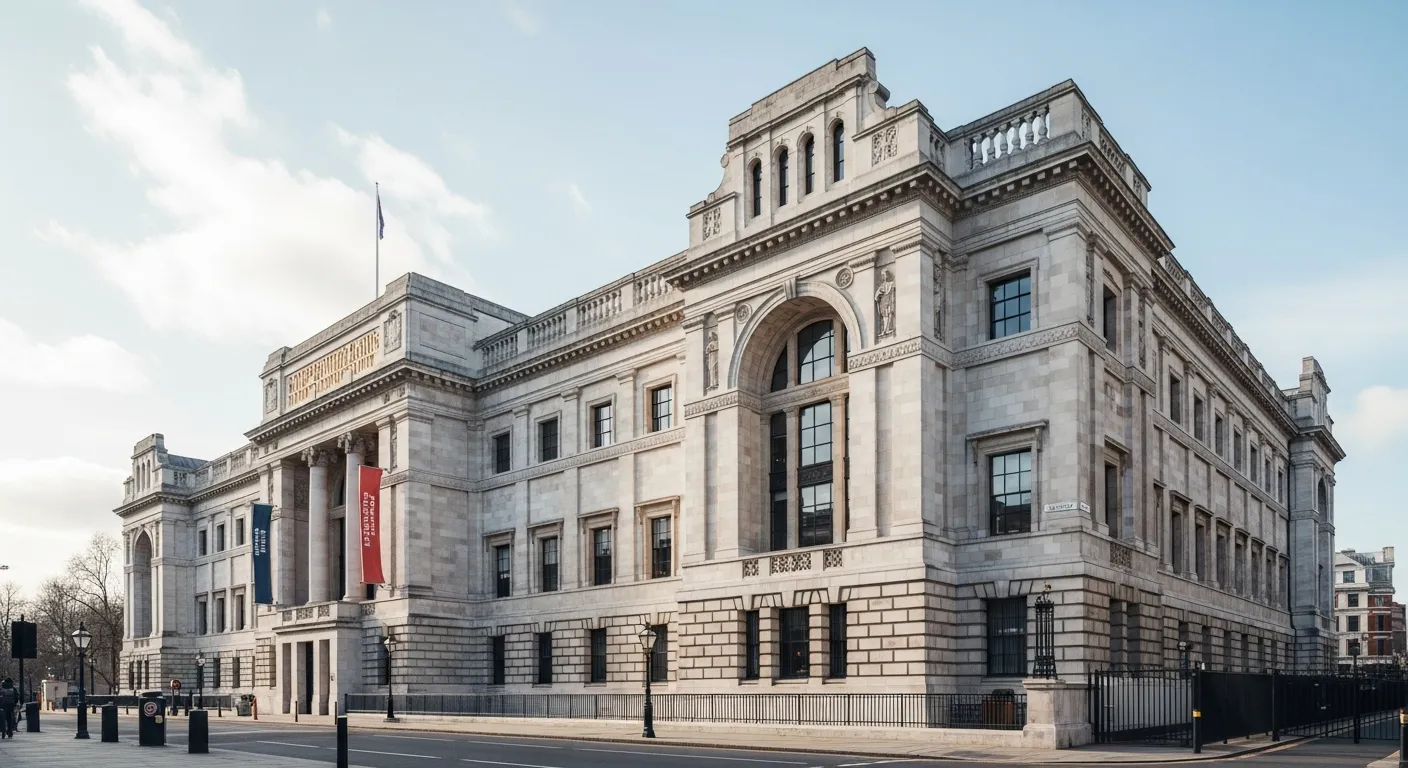
The British Museum, located in the Bloomsbury area of London, United Kingdom, is a public institution dedicated to human history, art and culture. Open daily, 10:00 AM – 5:00 PM; Fridays until 8:30 PM. Admission: free standard admission. Allow 2–4 hours and book a timed ticket ahead.
Visitor information last reviewed 25 September 2026. Check the official museum site for current details.
The British Museum at a glance: hours, tickets and time needed
| Opening hours | Daily: 10:00 AM – 5:00 PM; Fridays until 8:30 PM |
|---|---|
| Closed | 24–26 December |
| Last entry | 8:15 PM on Fridays |
| Admission | Free standard admission |
| Free access | Permanent collection always free · Free timed ticket recommended to guarantee entry · Friday lates free · Special exhibitions ticketed |
| Booking | Book a timed ticket in advance — peak slots sell out |
| Time needed | 2–4 hours |
| Best time to visit | Weekday mornings — particularly Tuesday to Thursday — before 11 AM. |
| Getting there | Metro: Holborn (Central & Piccadilly lines) — 2-minute walk via Museum Street |
| Address | Great Russell St, London WC1B 3DG, United Kingdom |
| Official website | britishmuseum.org |
Checked 2026-09-25 against the official website. Prices and hours change — confirm before you travel.
What is the British Museum known for?
The British Museum, located in the Bloomsbury area of London, United Kingdom, is a public institution dedicated to human history, art and culture. Its permanent collection of some eight million works is among the largest and most comprehensive in existence.
It documents the story of human culture from its beginnings to the present. The British Museum was the first public national museum in the world.
The museum was established in 1753, largely based on the collections of the Irish physician and scientist Sir Hans Sloane. It first opened to the public on 15 January 1759, in Montagu House, on the site of the current building.
Its expansion over the following 250 years was largely a result of expanding British colonisation and has resulted in the creation of several branch institutions.
Best for: History Enthusiasts · Families · First-timers · Art Lovers
What's on at the British Museum: current exhibitions
Updated September 2026. Confirm dates and tickets on the official British Museum website.
The Bayeux Tapestry
10 September 2026 – 11 July 2027The 70-metre, 11th-century embroidery of the Norman Conquest of 1066, lent by France and shown in England for the first time since it was made. Room 30, entered from the Great Court; about 40 minutes on a one-way route.
Tickets: £25–£33 adults (off-peak to standard); under-16s free. Timed ticket required for everyone — 2026 dates sold out; January–March 2027 tickets on sale 21 October 2026
Korea
Opens soon · 1 October 2026 – 31 January 2027A survey of 2,000 years of Korean sculpture, painting and decorative arts, drawn mostly from the Lee Kun-Hee bequest to Korea's national museums.
Tickets: Ticketed (see the official page for current prices); under-16s free
Declaring independence: USA 250
Until 29 November 2026A free display in Room 3 for the 250th anniversary of the US Declaration of Independence, built around the Washington Peace Medal.
Tickets: Free
Making the Most of Free Entry
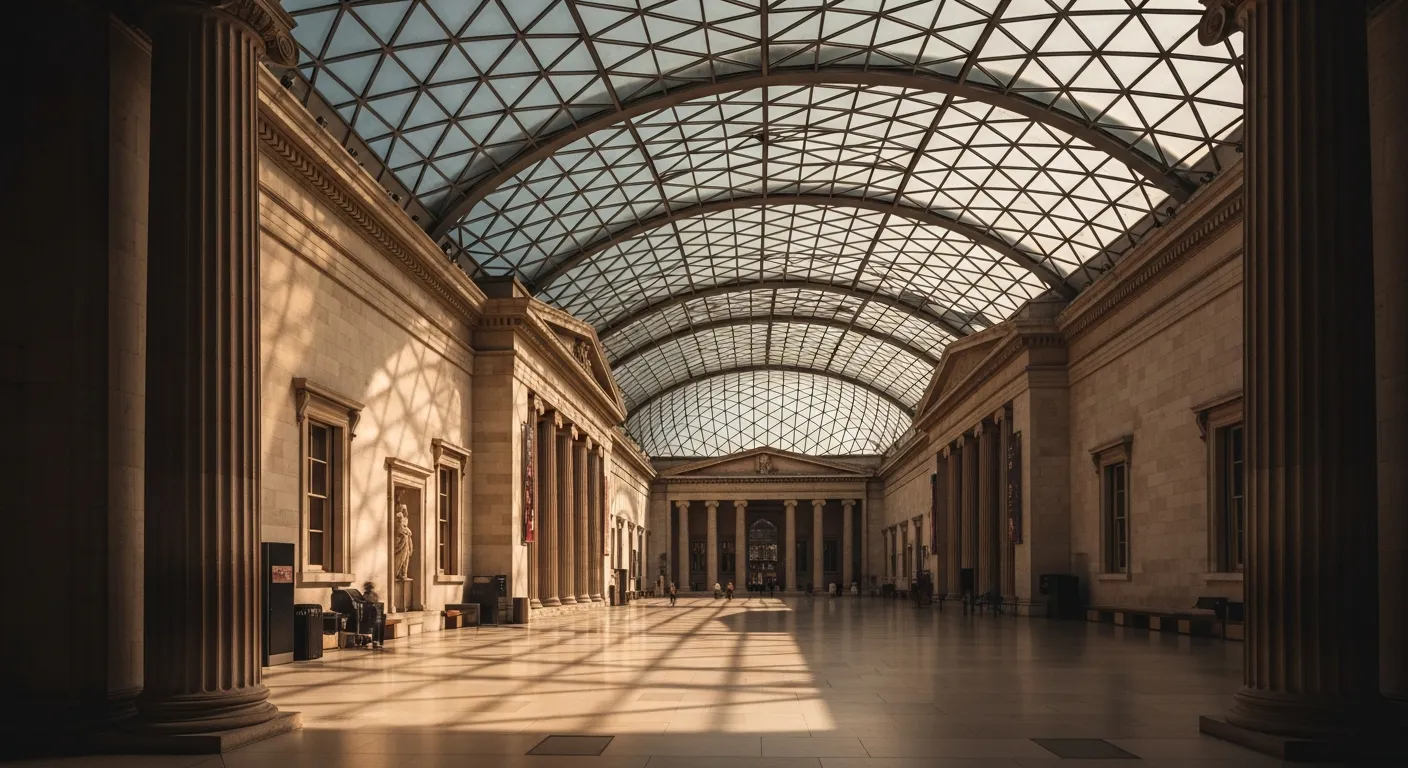
The British Museum charges no general admission fee, which makes it one of London's most accessible cultural destinations but also one of the busiest. The Great Court under its glass roof serves as a navigation hub, with the Information Desk providing paper maps essential for first visits. Security screening at main entrances can queue during school holidays, so arriving at opening time improves the experience in the Egyptian and Parthenon galleries. The Montague Place entrance on the north side offers an alternative queue that many tourists overlook entirely. Member mornings and exhibition previews provide calmer access for those willing to join the supporting membership program. Bloomsbury location places the museum within walking distance of Charles Dickens Museum and Russell Square gardens for a full neighborhood day.
Timed exhibition tickets for temporary shows are separate from permanent collection entry and often sell out for blockbuster loans. The museum's controversial acquisition history, particularly the Parthenon sculptures and Benin bronzes, is addressed in updated gallery interpretation that visitors should read alongside the objects. Audio guides and free daily eye-opener tours offer structured introductions without cost. The Reading Room in the Great Court, once open to registered researchers, now serves as exhibition space with limited public entry. Room numbering follows a logical geographic and chronological scheme once you understand the color-coded map legend. The museum publishes updated provenance research online for contested objects, worth reading before controversial galleries. The Great Court roof by Foster and Partners transformed the inner courtyard into Europe's largest covered public square when it opened in 2000.
Food options inside the Great Court restaurant are convenient but pricey; Bloomsbury cafés on Museum Street provide alternatives. Bags are allowed but large luggage must be checked at the cloakroom. Allow three hours minimum for ancient civilisations highlights, or a full day if adding Asian, African, and Americas collections on upper floors. Coin and medal collections in upper galleries attract specialists but remain accessible to general visitors without appointment. Eye-opener tours lasting thirty minutes depart from the Great Court information desk and require no advance booking during museum hours.
A Museum of Human Civilisation
Founded in 1753, the British Museum pioneered the encyclopedic public museum model, gathering artefacts from every inhabited continent. Egyptian galleries hold more than fifty thousand objects, with mummies, temple fragments, and the Rosetta Stone drawing constant crowds. Greek and Roman rooms present the Parthenon marbles, the Nereid Monument, and the Townley Discobolus among canonical classical works. The Reading Room in the Great Court, once open to registered researchers, now serves as exhibition space with limited public entry. Room numbering follows a logical geographic and chronological scheme once you understand the color-coded map legend. The museum publishes updated provenance research online for contested objects, worth reading before controversial galleries. Enlightenment Gallery in Room 1 preserves Sir Hans Sloane's original collecting philosophy that seeded the entire British Museum institution.
Assyrian relief panels from Nimrud and Nineveh rank among the largest stone carvings transported to Europe, depicting royal hunts and lion slayings at monumental scale. The Enlightenment Gallery preserves the original eighteenth-century display aesthetic, explaining how classification systems shaped modern museums. Living cultures galleries on upper floors present Africa, Oceania, and the Americas with increasing emphasis on community consultation and provenance research. Coin and medal collections in upper galleries attract specialists but remain accessible to general visitors without appointment. Africa, Oceania, and Americas galleries on upper floors present living cultures alongside archaeological material with updated community consultation labels.
Photography without flash is permitted in most galleries, supporting the museum's educational mission. Scholarly access to study rooms requires advance appointment for prints, drawings, and coins not on public display. The British Museum remains a research institution as much as a tourist destination, with conservation labs and library holdings supporting global archaeology. The museum library and conservation departments publish research online, making object labels starting points rather than final authority on contested histories.
Wing-by-wing visitor guide
Focused routes for The British Museum — pick one wing per visit to avoid museum fatigue.
Egyptian Sculpture and Mummies
⏱ 75 minutesRooms 4 and 62–63 concentrate Egypt's most iconic holdings, from colossal pharaoh heads to wrapped mummies in climate-controlled cases. The Rosetta Stone sits behind glass with interpretation explaining its role in deciphering hieroglyphs. Room 4 around the Rosetta Stone becomes impassable between 11 AM and 3 PM, so prioritize Egypt immediately at opening when possible.
- • Rosetta Stone in Room 4
- • Colossal bust of Ramesses II
- • Mummy cases and animal mummies in Room 62
- • Book of the Dead papyrus fragments
- • Limestone relief from tomb chapels
Greece and Rome
⏱ 90 minutesThe Parthenon galleries in Room 18 dominate public debate, but surrounding rooms offer equally significant classical sculpture, vases, and architecture fragments. The Nereid Monument reconstruction impresses with its scale. Room 18 Parthenon galleries include a continuous frieze display that helps visitors understand the temple's original sculptural program on the Acropolis.
- • Parthenon sculptures (Elgin Marbles) in Room 18
- • Nereid Monument from Xanthos
- • Townley Discobolus and Crouching Venus
- • Etruscan and South Italian red-figure vases
- • Roman portrait busts and sarcophagi
Assyria and Mesopotamia
⏱ 60 minutesAssyrian palace reliefs from Nineveh line long galleries with hunting scenes and winged genii at human scale or larger. These rooms are often quieter than Egypt and Greece while offering equally dramatic visual impact. Assyrian lamassu guardian figures from palace gates stand at human height or taller, conveying royal power through scale and carved detail.
- • Royal lion hunt reliefs from Nineveh
- • Winged bulls (lamassu) from palace gates
- • Standard of Ur and Royal Game of Ur
- • Ishtar Gate glazed brick fragments
- • Cuneiform tablets in Mesopotamia rooms
How long do you need at the British Museum?
Allow 2–4 hours. A focused route through 5 must-see highlights at The British Museum without museum fatigue. Follow the stops in order:
- 1
Rosetta Stone
📍 Room 4, Egyptian Sculpture Gallery
A granodiorite stele inscribed with a priestly decree in three scripts: hieroglyphics, Demotic, and Greek.
- 2
Parthenon Sculptures (Elgin Marbles)
📍 Room 18, Duveen Gallery
Marble sculptures from the Parthenon on Athens' Acropolis — including the frieze, metopes, and pedimental figures.
- 3
Sutton Hoo Helmet
📍 Room 41, Medieval Europe
An iconic iron helmet found in an Anglo-Saxon royal burial mound in Suffolk in 1939.
- 4
Hoa Hakananai'a
📍 Room 24
A volcanic basalt moai (ancestor figure) from Easter Island.
- 5
Lewis Chessmen
📍 Room 40, Europe Gallery
93 medieval chess pieces carved from walrus ivory and whale teeth, discovered on the Isle of Lewis in 1831.
What are the must-see works at the British Museum?
5 highlights that define the collection: Rosetta Stone, Parthenon Sculptures (Elgin Marbles), Sutton Hoo Helmet and more.
Rosetta Stone
Ancient Egyptian · 196 BCE
📍 Room 4, Egyptian Sculpture Gallery
A granodiorite stele inscribed with a priestly decree in three scripts: hieroglyphics, Demotic, and Greek. Discovered in 1799 during Napoleon's campaign, it was the key to deciphering ancient Egyptian hieroglyphics.
Parthenon Sculptures (Elgin Marbles)
Pheidias and workshop · c. 447–432 BCE
📍 Room 18, Duveen Gallery
Marble sculptures from the Parthenon on Athens' Acropolis — including the frieze, metopes, and pedimental figures. Their removal from Greece (1801–12) by Lord Elgin remains one of the great repatriation debates in museum history.
Sutton Hoo Helmet
Anglo-Saxon craftsman · Early 7th century CE
📍 Room 41, Medieval Europe
An iconic iron helmet found in an Anglo-Saxon royal burial mound in Suffolk in 1939. Its haunting face-mask has become one of the most powerful images of early medieval Britain.
Hoa Hakananai'a
Rapanui people · c. 1000–1200 CE
📍 Room 24
A volcanic basalt moai (ancestor figure) from Easter Island. The name translates as "hidden or stolen friend." It is considered one of the finest examples of Rapanui carving and one of the museum's most contested objects.
Lewis Chessmen
Norse craftspeople · c. 1150–1200 CE
📍 Room 40, Europe Gallery
93 medieval chess pieces carved from walrus ivory and whale teeth, discovered on the Isle of Lewis in 1831. Their expressive faces — including a bishop biting his shield — have made them among the most beloved objects in the museum.
Collections and highlights
- • Rosetta Stone
- • Parthenon Sculptures
- • Hoa Hakananai'a
- • Sutton Hoo helmet
- • Cyrus Cylinder
Tips for visiting the British Museum
- 1.
Best time to visit
Weekday mornings — particularly Tuesday to Thursday — before 11 AM. Weekends and school holidays see the highest visitor numbers.
- 2.
Tickets & booking
General admission is entirely free — no booking required. For popular temporary exhibitions, book online in advance to guarantee entry. Bag storage lockers are available in the Great Court.
- 3.
Accessibility
Fully accessible with step-free routes throughout. Wheelchairs available to borrow free of charge at the Great Court. Blue Badge parking nearby. Tactile tours, audio descriptions, and BSL-interpreted events are offered regularly.
- 4.
Photography rules
Photography for personal use is freely permitted throughout the permanent galleries. Commercial photography requires prior written permission from the museum.
How do you get to the British Museum?
- metro Holborn (Central & Piccadilly lines) — 2-minute walk via Museum Street
- metro Tottenham Court Road (Central & Northern lines) — 8-minute walk
- metro Russell Square (Piccadilly line) — 7-minute walk
- bus Lines 1, 8, 19, 25, 38, 55, 98 — stop: Museum Street / New Oxford Street
Address: Great Russell St, London WC1B 3DG, United Kingdom
The British Museum: frequently asked questions
Is the British Museum free?
Yes — general admission to the British Museum's permanent collection is entirely free. Special temporary exhibitions carry a separate ticket price (typically £20–£25). There is no booking fee for free admission, though timed tickets are recommended during busy periods.
Is the Bayeux Tapestry at the British Museum?
Yes — the Bayeux Tapestry is on loan from France and on show at the British Museum from 10 September 2026 to 11 July 2027, the first time it has been displayed in England since it was made. It is in Room 30 (the Sainsbury Exhibitions Gallery), entered from the Great Court, and the one-way route takes about 40 minutes.
How much are Bayeux Tapestry tickets at the British Museum?
Adult tickets cost £25–£33 depending on the time slot (super off-peak, off-peak or standard); under-16s go free with an adult. Everyone needs a timed ticket, including under-16s and Members. Slots for 2026 are sold out; tickets for January–March 2027 go on sale on 21 October 2026, with April–July 2027 released in early 2027.
What are the must-see highlights at the British Museum?
The Rosetta Stone (Room 4) — the key to deciphering ancient Egyptian hieroglyphics; the Parthenon Sculptures / Elgin Marbles (Room 18) — Classical Greek marble friezes from the Parthenon; the Sutton Hoo Helmet (Room 41) — the most famous Anglo-Saxon artefact ever found; the Lewis Chessmen (Room 40) — 12th-century Norse chess pieces; and the Hoa Hakananai'a Easter Island statue (Room 24).
What is the Rosetta Stone and why is it significant?
The Rosetta Stone is a granodiorite stele inscribed with the same priestly decree in three scripts — Ancient Egyptian hieroglyphs, Demotic script, and ancient Greek. Discovered by Napoleon's troops in 1799, it enabled scholars (most famously Jean-François Champollion in 1822) to decipher Egyptian hieroglyphics for the first time in over 1,400 years, unlocking the entire written record of ancient Egypt.
Should the Elgin Marbles be returned to Greece?
This is a major ongoing international debate. The Parthenon Sculptures — marble friezes, figures, and a centrepiece frieze from the Parthenon in Athens — were removed by Lord Elgin between 1801 and 1812, when Greece was under Ottoman rule. Greece has sought their return since 1983, arguing they are an inseparable part of the Parthenon monument. The British Museum maintains they were legally acquired and are better served in London as part of a world collection. Active negotiations between the British Museum and the Acropolis Museum in Athens are ongoing.
How long does it take to visit the British Museum?
The British Museum has 8 million objects across over 90 galleries. A focused visit to the main highlights — Egypt, Greece, and the Sutton Hoo treasure — takes 2–3 hours. A thorough visit requires a full day. The museum offers free floor maps and a highlights trail at the information desk.
How long should I spend at The British Museum?
Plan 2–4 hours for the highlights of the British Museum. Our 5-stop route — Rosetta Stone, Parthenon Sculptures (Elgin Marbles), Sutton Hoo Helmet and more — is designed to fit that time. Add extra time for temporary exhibitions, the shop and the café.
Is the British Museum open on Mondays?
Yes — the British Museum is open every day of the week, including Mondays and Sundays: 10:00 AM – 5:00 PM; Fridays until 8:30 PM. It closes on 24–26 December. Check the official website for holiday hours.
What are the British Museum's opening hours?
The British Museum is open daily, 10:00 AM – 5:00 PM; Fridays until 8:30 PM, and closed 24–26 December. Last entry: 8:15 PM on Fridays. Hours can change for holidays and events, so check the official website before you go.