Apartheid Museum
Johannesburg · South Africa · Founded 2001
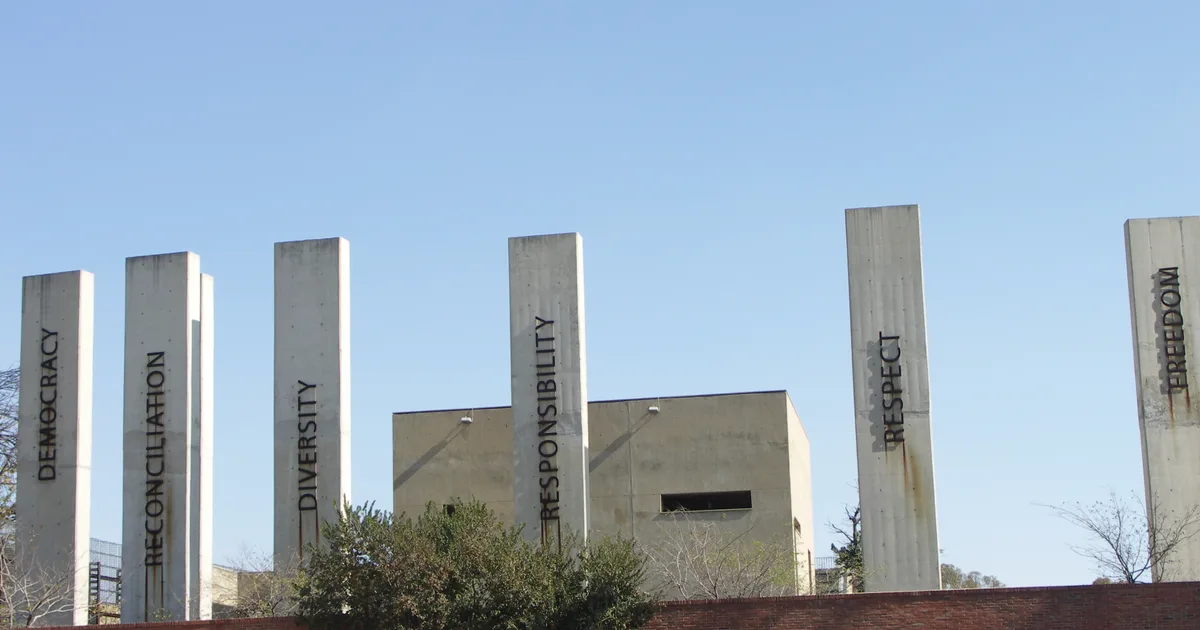
Quick answer
Apartheid Museum in Johannesburg, South Africa — the Apartheid Museum opened in 2001 on a seven-hectare site next to Gold Reef City in Johannesburg. Open Tuesday to Sunday: 9:00 AM – 5:00 PM; closed Mondays. Admission: From R150 standard admission. Allow 2–3 hours.
Visitor information last reviewed 30 June 2026. Check the official museum site for current details.
Apartheid Museum at a glance: hours, tickets and time needed
| Opening hours | Tuesday to Sunday: 9:00 AM – 5:00 PM |
|---|---|
| Closed | Mondays |
| Admission | From R150 standard admission |
| Free or reduced entry | Children under 12 free on select days |
| Booking | Tickets usually available on the day |
| Time needed | 2–3 hours |
| Best time to visit | Weekday mornings for a quieter, more reflective experience. |
| Getting there | Car: On Northern Parkway next to Gold Reef City theme park — ample parking on site |
| Address | Northern Parkway & Gold Reef Rd, Ormonde, Johannesburg, South Africa |
| Official website | apartheidmuseum.org |
Checked 2026-06-30 against the official website. Prices and hours change — confirm before you travel.
What is Apartheid Museum known for?
The Apartheid Museum opened in 2001 on a seven-hectare site next to Gold Reef City in Johannesburg. It was the first museum in South Africa dedicated to documenting the apartheid era and the struggle for democracy — conceived before the Truth and Reconciliation Commission had completed its work.
Visitors enter through gates marked 'White' and 'Non-White' and receive entry tickets randomly assigning them a racial classification — an immediate, visceral introduction to the daily humiliations of the apartheid pass system. The exhibition then unfolds chronologically from segregation through resistance to liberation.
The museum is text-heavy, film-rich, and emotionally demanding. It is widely regarded as essential for understanding modern South Africa — not a comfortable experience, but a necessary one.
Best for: History Enthusiasts
How long do you need at Apartheid Museum?
Allow 2–3 hours. A focused route through 4 must-see highlights at Apartheid Museum without museum fatigue. Follow the stops in order:
- 1
Racial Classification Entry Gates
📍 Entrance
Two gates — White and Non-White — force every visitor to experience the arbitrary racial classification that governed daily life under apartheid.
- 2
Hector Pieterson Memorial
📍 1976 Uprising Gallery
The story of the 1976 Soweto uprising centred on 12-year-old Hector Pieterson, whose death was captured in Sam Nzima's iconic photograph — a turning point in the anti-apartheid struggle.
- 3
Solitary Confinement Cell
📍 Resistance Gallery
A reconstructed prison cell where political detainees were held in isolation — visitors can enter the cramped space to experience the conditions endured by activists.
- 4
Truth and Reconciliation Commission Archive
📍 Liberation Gallery
Video testimony from the TRC hearings — victims and perpetrators confronting the human cost of apartheid in their own words.
What are the must-see works at Apartheid Museum?
4 highlights that define the collection: Racial Classification Entry Gates, Hector Pieterson Memorial, Solitary Confinement Cell and more.
Racial Classification Entry Gates
Museum design · 2001
📍 Entrance
Two gates — White and Non-White — force every visitor to experience the arbitrary racial classification that governed daily life under apartheid.
Hector Pieterson Memorial
Curatorial installation · permanent
📍 1976 Uprising Gallery
The story of the 1976 Soweto uprising centred on 12-year-old Hector Pieterson, whose death was captured in Sam Nzima's iconic photograph — a turning point in the anti-apartheid struggle.
Solitary Confinement Cell
Reconstruction · permanent
📍 Resistance Gallery
A reconstructed prison cell where political detainees were held in isolation — visitors can enter the cramped space to experience the conditions endured by activists.
Truth and Reconciliation Commission Archive
Archival installation · permanent
📍 Liberation Gallery
Video testimony from the TRC hearings — victims and perpetrators confronting the human cost of apartheid in their own words.
Collections and highlights
- • Racial classification entry experience
- • 1976 Soweto uprising gallery
- • Political imprisonment and resistance
- • Truth and Reconciliation Commission archive
- • Nelson Mandela liberation gallery
Tips for visiting Apartheid Museum
- 1.
Best time to visit
Weekday mornings for a quieter, more reflective experience. Allow at least 2–3 hours — many visitors stay longer.
- 2.
Tickets & booking
Tickets at the entrance — from R150. The museum is closed Mondays.
- 3.
Accessibility
The museum is fully accessible with ramps and lifts throughout.
- 4.
Photography rules
Photography is generally not permitted inside the galleries. Respect the solemnity of the space.
How do you get to Apartheid Museum?
- car On Northern Parkway next to Gold Reef City theme park — ample parking on site
- taxi Uber or taxi from Johannesburg CBD — approximately 20 minutes
- bus Limited public transport — taxi or car recommended
- walk Not walkable from central Johannesburg — a car or taxi is essential
Address: Northern Parkway & Gold Reef Rd, Ormonde, Johannesburg, South Africa
Apartheid Museum: frequently asked questions
How long does the Apartheid Museum take?
Allow at least 2–3 hours. The museum is emotionally intense and text-heavy — many visitors spend longer. It is an essential stop for understanding modern South African history.
How long should I spend at Apartheid Museum?
Plan 2–3 hours for the highlights of Apartheid Museum. Our 4-stop route — Racial Classification Entry Gates, Hector Pieterson Memorial, Solitary Confinement Cell and more — is designed to fit that time. Add extra time for temporary exhibitions, the shop and the café.
What is Apartheid Museum best known for?
A powerful museum documenting South Africa's apartheid era and the struggle for democracy — visitors receive racially classified entry tickets mirroring the apartheid pass system. Key highlights include Racial classification entry experience, 1976 Soweto uprising gallery, Political imprisonment and resistance.
How do I get tickets for Apartheid Museum?
Admission: From R150 standard admission. Tickets are usually available on the day, but booking online saves queue time in peak season. Official site: https://www.apartheidmuseum.org/
Why do visitors get random race classifications at entry?
It recreates the experience of the apartheid pass system, where every person was classified White, Coloured, Indian, or Black — determining where they could live, work, and travel. The random assignment makes every visitor confront the arbitrariness of racial classification.
Is the Apartheid Museum appropriate for teenagers?
Yes — the museum is widely used in South African school curricula. Some content about torture and violence is disturbing. Parental guidance is recommended for children under 12.
Can I visit the Apartheid Museum and Constitution Hill in one day?
Yes — both are in Johannesburg and together provide a comprehensive picture of apartheid and the transition to democracy. Allow a full day for both.
Is Apartheid Museum open on Mondays?
No — Apartheid Museum is closed every Monday. It is open Tuesday to Sunday: 9:00 AM – 5:00 PM. Plan a different museum for that day, and check the official website for holiday changes.
What are Apartheid Museum's opening hours?
Apartheid Museum is open Tuesday to Sunday: 9:00 AM – 5:00 PM, and closed Mondays. Hours can change for holidays and events, so check the official website before you go.
Is Apartheid Museum free to visit?
No — standard admission is From R150 standard admission. Exceptions: Children under 12 free on select days.