Alte Pinakothek
Quick answer
Alte Pinakothek in Munich, Germany — the Alte Pinakothek is one of the world's oldest public art galleries, opened in 1836 by King Ludwig I of Bavaria to house the Wittelsbach dynasty's extraordinary painting collection. Open Tuesday to Sunday: 10:00 AM – 6:00 PM; closed Mondays. Admission: €7 standard admission (€1 on Sundays). Allow 2–3 hours.
Visitor information last reviewed 30 June 2026. Check the official museum site for current details.
Alte Pinakothek at a glance: hours, tickets and time needed
| Opening hours | Tuesday to Sunday: 10:00 AM – 6:00 PM |
|---|---|
| Closed | Mondays |
| Admission | €7 standard admission (€1 on Sundays) |
| Free or reduced entry | €1 admission every Sunday · Under 18 free |
| Booking | Tickets usually available on the day |
| Time needed | 2–3 hours |
| Best time to visit | Tuesday or Wednesday mornings at 10 AM opening — galleries are quiet before tour groups arrive. |
| Getting there | Metro: U2 to Königsplatz or U3/U6 to Universität — both a 5-minute walk through the Kunstareal |
| Address | Barer Str. 27, 80333 Munich, Germany |
| Official website | pinakothek.de |
Checked 2026-06-30 against the official website. Prices and hours change — confirm before you travel.
What is Alte Pinakothek known for?
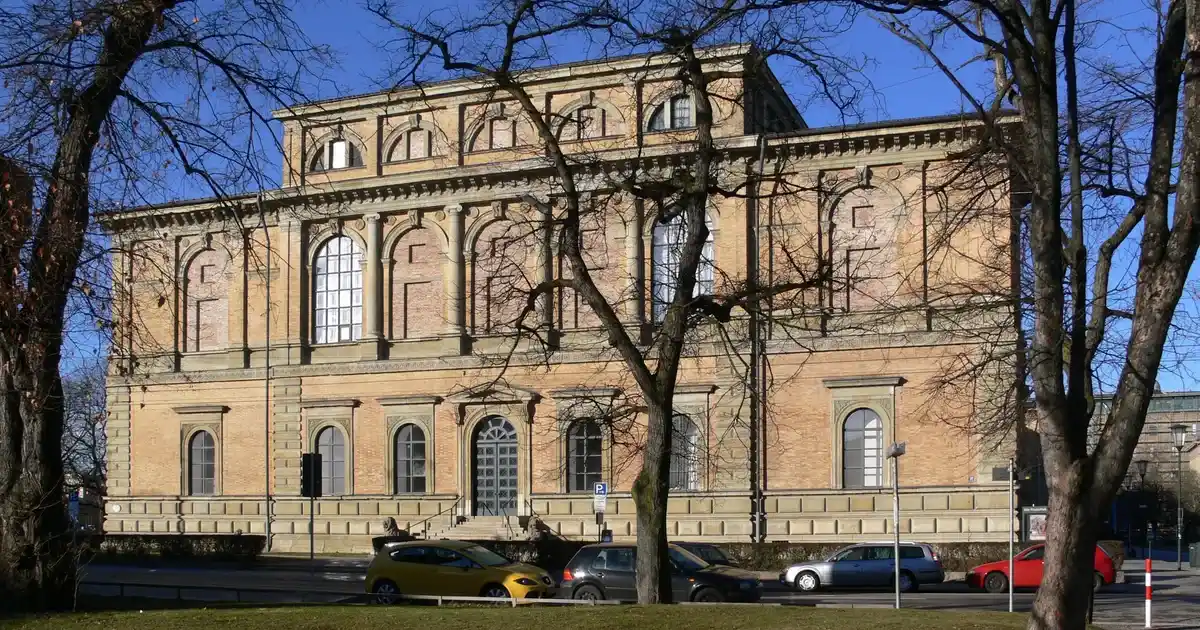
The Alte Pinakothek is one of the world's oldest public art galleries, opened in 1836 by King Ludwig I of Bavaria to house the Wittelsbach dynasty's extraordinary painting collection. Designed by Leo von Klenze, its long neoclassical facade on Barer Strasse anchors Munich's Kunstareal — a museum quarter that also includes the Neue Pinakothek, the Pinakothek der Moderne, and the Brandhorst Museum.
The collection spans European painting from the 14th to the 18th century with unmatched depth in German and Flemish masters. Albrecht Dürer's Self-Portrait at 28, Rubens's Last Judgment, and Leonardo da Vinci's Madonna of the Carnation are among the most celebrated works. The gallery holds one of Europe's finest assemblies of Old Master paintings outside the great royal collections of London, Madrid, and Vienna.
Ludwig I conceived the Pinakothek as a temple to art education, and the museum's systematic hang — organised by school and chronology — still reflects that Enlightenment ambition. Major strengths include the German Renaissance (Dürer, Cranach, Altdorfer), the Dutch Golden Age (Rembrandt, van Dyck, van Honthorst), and Italian Renaissance and Baroque painting from Giotto through Tiepolo.
Rebuilt after wartime bombing and reopened in 1957, the Alte Pinakothek remains Munich's most essential art destination. Sunday admission drops to €1, making it one of the best-value museum visits in Europe. Combined tickets with the Neue Pinakothek and Pinakothek der Moderne offer excellent value for a full day in the Kunstareal.
Best for: Art Lovers · History Enthusiasts
How long do you need at Alte Pinakothek?
Allow 2–3 hours. A focused route through 4 must-see highlights at Alte Pinakothek without museum fatigue. Follow the stops in order:
- 1
Self-Portrait at 28
📍 Room II, German Renaissance
Dürer's celebrated self-portrait at the height of his powers — the artist depicted as Christ-like, gazing directly at the viewer with extraordinary technical precision.
- 2
The Last Judgment
📍 Room XVIII, Flemish Baroque
A monumental triptych of apocalyptic drama painted for the Jesuit church in Neuburg an der Donau.
- 3
Madonna of the Carnation
📍 Room VIII, Italian Renaissance
An early Leonardo Madonna showing the young artist's mastery of sfumato and intimate domestic sacred imagery.
- 4
The Land of Cockaigne
📍 Room XIV, Dutch & Flemish
Bruegel's satirical vision of a medieval paradise where food falls from the sky — a moralising commentary on gluttony rendered with the artist's characteristic eye for peasant life.
What are the must-see works at Alte Pinakothek?
4 highlights that define the collection: Self-Portrait at 28, The Last Judgment, Madonna of the Carnation and more.
Self-Portrait at 28
Albrecht Dürer · 1500
📍 Room II, German Renaissance
Dürer's celebrated self-portrait at the height of his powers — the artist depicted as Christ-like, gazing directly at the viewer with extraordinary technical precision. One of the most famous self-portraits in Western art and the definitive image of the German Renaissance.
The Last Judgment
Peter Paul Rubens · c. 1618
📍 Room XVIII, Flemish Baroque
A monumental triptych of apocalyptic drama painted for the Jesuit church in Neuburg an der Donau. Rubens deploys swirling bodies, fire, and light across three panels with the kinetic energy that defined Flemish Baroque painting at its peak.
Madonna of the Carnation
Leonardo da Vinci · c. 1478
📍 Room VIII, Italian Renaissance
An early Leonardo Madonna showing the young artist's mastery of sfumato and intimate domestic sacred imagery. One of only a handful of Leonardo paintings in Germany.
The Land of Cockaigne
Pieter Bruegel the Elder · 1567
📍 Room XIV, Dutch & Flemish
Bruegel's satirical vision of a medieval paradise where food falls from the sky — a moralising commentary on gluttony rendered with the artist's characteristic eye for peasant life.
Collections and highlights
- • German Renaissance — Dürer, Cranach, Altdorfer, and Holbein
- • Flemish Baroque — Rubens, van Dyck, and Jordaens
- • Italian Renaissance — Raphael, Titian, Botticelli, and Leonardo
- • Dutch Golden Age — Rembrandt, Hals, and van Honthorst
- • Spanish painting — El Greco, Murillo, and Velázquez
- • French Rococo — Boucher, Fragonard, and Watteau
- • English portraiture — Gainsborough, Reynolds, and Lawrence
- • Neoclassical and early Romantic — Friedrich and Delacroix
Tips for visiting Alte Pinakothek
- 1.
Best time to visit
Tuesday or Wednesday mornings at 10 AM opening — galleries are quiet before tour groups arrive. Sunday is popular but only €1 admission.
- 2.
Crowds & busy periods
Weekends and school holidays see moderate crowds in the Dürer and Rubens rooms. The long enfilade galleries absorb visitors well.
- 3.
Tickets & booking
Buy online at pinakothek.de for skip-the-line entry. Combined day ticket for all three Pinakothek museums costs €12. Under-18s free.
- 4.
Food & cafés nearby
Café in the museum foyer; numerous restaurants on Barer Strasse and Türkenstrasse within 5 minutes.
- 5.
Accessibility
Fully accessible with elevators and wheelchair loan at reception. Audio guides available in multiple languages.
How do you get to Alte Pinakothek?
- metro U2 to Königsplatz or U3/U6 to Universität — both a 5-minute walk through the Kunstareal
- tram Tram 27 or 28 to Pinakotheken — stops directly outside the museum entrance
- walk 15 minutes from Munich Hauptbahnhof via Karlsplatz and the Kunstareal boulevard
Address: Barer Str. 27, 80333 Munich, Germany
Alte Pinakothek: frequently asked questions
What is the Alte Pinakothek famous for?
Dürer's Self-Portrait at 28, Rubens's Last Judgment, Leonardo's Madonna of the Carnation, and one of Europe's greatest collections of Old Master paintings from the 14th to 18th centuries.
How long should I spend at Alte Pinakothek?
Plan 2–3 hours for the highlights of Alte Pinakothek. Our 4-stop route — Self-Portrait at 28, The Last Judgment, Madonna of the Carnation and more — is designed to fit that time. Add extra time for temporary exhibitions, the shop and the café.
What is Alte Pinakothek best known for?
One of the world's oldest and most important art galleries — Old Masters from Dürer and Rubens to Leonardo, Raphael, and Rembrandt in a Ludwig I neoclassical building. Key highlights include German Renaissance — Dürer, Cranach, Altdorfer, and Holbein, Flemish Baroque — Rubens, van Dyck, and Jordaens, Italian Renaissance — Raphael, Titian, Botticelli, and Leonardo.
How do I get tickets for Alte Pinakothek?
Admission: €7 standard admission (€1 on Sundays). Tickets are usually available on the day, but booking online saves queue time in peak season. Official site: https://www.pinakothek.de/en/alte-pinakothek
Can I visit all three Pinakothek museums in one day?
Yes — the Alte, Neue, and Moderne Pinakotheken sit within a 5-minute walk in the Kunstareal. A combined day ticket at €12 is excellent value. Allow 2–3 hours for the Alte Pinakothek alone; a full Kunstareal day needs 6–8 hours.
Which rooms should I prioritise on a short visit?
Start with Room II for Dürer's Self-Portrait, then Room XVIII for Rubens's Last Judgment, Room VIII for Leonardo's Madonna of the Carnation, and Room XIV for Bruegel. These four rooms contain the most celebrated masterpieces and can be seen in 90 minutes.
Is photography allowed in the Alte Pinakothek?
Photography without flash is permitted in the permanent collection galleries. Tripods and selfie sticks are not allowed. Special exhibitions may have separate photography policies.
Is Alte Pinakothek open on Mondays?
No — Alte Pinakothek is closed every Monday. It is open Tuesday to Sunday: 10:00 AM – 6:00 PM. Plan a different museum for that day, and check the official website for holiday changes.
What are Alte Pinakothek's opening hours?
Alte Pinakothek is open Tuesday to Sunday: 10:00 AM – 6:00 PM, and closed Mondays. Hours can change for holidays and events, so check the official website before you go.
Is Alte Pinakothek free to visit?
Not for everyone. Standard admission: €7 standard admission (€1 on Sundays). Free or reduced entry: €1 admission every Sunday; Under 18 free.
